Listen to Teaching Iris · 14 minutes
An Iris is taught through FourThought.
FourThought is an expressive staking dialectic through which people record claims and questions with enough structure for an Iris to learn how a person or community perceives the world. It does not prescribe one universal objective, one finished moral constitution, or one exhaustive set of reward signals. It provides a shared language through which different people can teach different Irises what deserves attention.
The Prophet Incentive and Social Proof of Impact are two established mechanisms within Cognicism. Fruitful questioning and reflective compression are also ways an Iris can be tuned through the FourThought record. They are not the only ways. They demonstrate how much can be expressed through the dialectic.
An Iris oriented toward scientific discovery may be taught differently from one supporting a neighborhood, institution, watershed, archive, or financial market. Each can learn from different relationships between sources, claims, questions, values, and outcomes while remaining grounded in the same interoperable protocol.
FourThought as a Staking Dialectic
FourThought gives people four forms in which to stake information:
- Reflections make claims about the past.
- Statements make claims about the present.
- Predictions make claims about the future.
- Questions stake the value of seeking knowledge in a particular direction.
The types make explicit how a thought relates to time and uncertainty. A prediction cannot be evaluated in the same way as a reflection because the event it describes has not happened yet. A question is not a failed statement. It does not assert an answer; it declares that resolving an uncertainty is worth attention.
Each stake can carry:
- its content;
- its source;
- its timestamp;
- its thought type;
- its verity;
- its valence;
- its relationship to prior thoughts;
- its privacy and distribution scope.
Verity records the speaker’s perception of how true or false a claim is. Valence records the speaker’s perception of whether its meaning or outcome is wanted, unwanted, beneficial, harmful, or morally aligned.
This is substantially more expressive than a like, vote, token transfer, or simple preference ranking. A vote records which option won at one moment. A FourThought ledger can preserve what people believed about the past, present, and future; how certain they were; what they wanted; who spoke; what they were responding to; and how those perceptions changed.
FourThought does not need to capture all language. It captures beliefs and questions people consider meaningful enough to stake to a shared record. Those stakes become a moving representation of collective perception from which Iris can learn.
The Rhizome Feedback Loop
The Rhizome staking widget turns alignment into a visible feedback process.
When someone writes a thought, the model predicts:
- whether it is a reflection, statement, prediction, or question;
- the verity implied by the language;
- the valence implied by the language.
The person sees those predictions before staking the thought.
This gives them immediate feedback about what the model thinks they mean. If the model reads certainty where they intended doubt, they can adjust the verity slider. If it reads moral neutrality where they intended a strongly wanted or unwanted outcome, they can adjust the valence slider. If it misunderstands the temporal or epistemic form of the thought, they can change its type.
The model’s interpretation is not silently substituted for the speaker’s perception. The person can correct it.
The final stake therefore contains a structured account of what the person actually meant. The difference between the model’s initial prediction and the person’s correction is itself valuable alignment information. The model learns how that person or community expresses certainty, uncertainty, desire, concern, memory, and expectation. The person simultaneously learns how their language is being interpreted by the model.
The feedback moves both ways.
This is a richer alignment process than conventional preference collection. Instead of only choosing response A over response B, a person expresses dimensions of meaning directly. They can say:
- what kind of thought this is;
- what they believe about its truth;
- what they feel about its value;
- what prior thought it answers or develops;
- whether it belongs in a private, local, or global context.
FourThought makes those dimensions legible to both the human and the Iris.
FourThought as RLHF
In ordinary reinforcement learning from human feedback, evaluators commonly rank outputs or apply scalar judgments. FourThought allows the human feedback to retain more of its internal structure.
Iris can generate a FourThought-compliant response containing content, type, verity, and valence. It can also predict how the community will respond, again as a complete FourThought thought rather than only a scalar reward. When real responses arrive, the difference between the predicted and actual response becomes a learning signal.
The model is therefore learning more than which sentence receives approval. It is learning how beliefs move:
- how a prediction ages;
- how a reflection changes the interpretation of an event;
- how a present statement relates to action;
- how a question produces new branches of inquiry;
- how verity and valence shift as consequences become visible;
- which sources prove useful in which contexts.
The response_to relationship makes some of this movement explicit. The embeddings over source, time, and content allow Iris to learn relational structure that was not explicitly linked. Human staking and model self-prediction operate through the same schema.
This creates a feedback-alignment process that remains open to inspection. People can see what they staked. They can see how the model interpreted it. They can see later responses and outcomes. The alignment substrate is an evolving public or local record rather than a hidden preference dataset assembled once and frozen.
Individual Irises
FourThought is expressive enough to shape many different Irises.
There is no requirement that every Iris converge on the same optimum. A community can decide what it needs its Iris to become attentive to. Its staking practices, evaluation patterns, selected objectives, and accumulated history teach the model.
An archive might emphasize the preservation and compression of historical knowledge. A mutual-aid community might emphasize whether staked actions produced wanted outcomes. A research group might emphasize difficult questions, minority hypotheses, and sources whose claims later become accepted. A market Iris might be trained across relational objectives involving sources, times, instruments, and reconstruction contexts.
These are uses of the dialectic, not separate ontological requirements imposed on every Iris.
Because the underlying stakes share a schema, heterogeneous Irises can remain interoperable. A local Iris can preserve its community’s context without pretending that its values are universal. A different Iris can learn a different attention distribution from the same or overlapping record. Knowledge that travels between them can retain its source, time, stated confidence, value context, and response history.
FourThought supplies the language. Communities teach through how they use it.
The Prophet Incentive
The Prophet Incentive is a Cognicist mechanism for rewarding sources that are ahead of the curve of collective belief.
Its strongest signal does not come from repeating what everyone already expects. It comes from staking a belief when it is uncertain, unpopular, or difficult to hear and then having reality and collective perception move toward it over time.
The timestamped record matters because hindsight otherwise erases the original disagreement. Once an idea becomes obvious, people behave as though it was always known. The ledger preserves who said what, when they said it, how confident they were, and what the surrounding consensus looked like at the time.
The Prophet Incentive is one way to use FourThought to tune an Iris. It teaches the model to attend to sources with demonstrated contextual foresight. It does not require every contribution to be a prediction. A statement, reflection, or question can also place someone ahead of a later shift in collective understanding. What matters is the temporal movement of belief around the stake.
Social Proof of Impact
Social Proof of Impact is another established Cognicist mechanism. It rewards staked claims and actions that help bring about outcomes the community wanted but did not yet believe were inevitable.
A person does not earn this signal simply by announcing good intentions. The signal develops posteriorly, as later discourse shows that the action occurred and that its effects carried positive valence.
If the Prophet Incentive asks who saw what was coming, Social Proof of Impact asks who helped change what came.
The mechanisms can exist in generative tension. Someone may accurately predict an unwanted future. That warning creates an opportunity for other people to act. If the intervention prevents the predicted outcome, the original prediction may not literally come true, but it may still have been the information that made prevention possible. Social Proof of Impact can reward the people who changed the trajectory while the Prophet Incentive preserves the value of the early warning.
This helps Iris learn from both foresight and action without declaring either one the entire purpose of the system.
Fruitful Questions
Questions demonstrate another way FourThought can tune an Iris.
A question is a stake in a direction of inquiry. It tells the community and the model that reducing this particular uncertainty may be valuable.
As developed in Fruitless Questions, a fruitful question can:
- generate measurable predictions or commitments;
- create new affordances for collective action;
- open unexplored conceptual terrain;
- attract coherent and sustained engagement;
- produce moral clarity or operational insight;
- reduce local uncertainty.
A fruitless question consumes attention without producing useful epistemic movement. It may create recursive uncertainty, untestable branches, cumulative valence decay, or an epistemic sinkhole from which no coordination or action can follow.
An Iris can be tuned to notice the difference by following what grows from a question. Did later reflections, statements, and predictions build upon it? Did it reduce uncertainty? Did it help the community discover something, revise a belief, or act?
Fruitful questioning is one technique available through FourThought. It is not a required fourth signal completing a canonical set. Its importance is that the protocol is expressive enough to credit the person who opens a valuable search direction even when they do not yet know the answer.
Reflective Compression
Reflective compression is another possible tuning objective.
Human communities cannot retain everything that happens to them. Shared history continually evolves while attention and memory remain finite. The problem is not merely storing records. It is deciding which lessons from the record should be carried forward and expressing them in forms people can hear and use.
Reflective compression rewards people who distill meaningful historical or collective knowledge into useful, actionable representations that others continue to build upon.
This is not generic summarization. A summary can shorten information while destroying what made it meaningful. Reflective compression preserves the causal, moral, and practical structure that makes knowledge useful. The compressed representation can itself be staked, attributed, evaluated, challenged, connected to evidence, and revised.
A historian can perform reflective compression. So can a teacher, mediator, storyteller, analyst, witness, engineer writing a postmortem, or community member who finally finds the language that lets other people understand what has been happening.
The contribution may not introduce a new fact. Its novelty is representational. Existing knowledge becomes collectively accessible because someone found the form in which it could be heard.
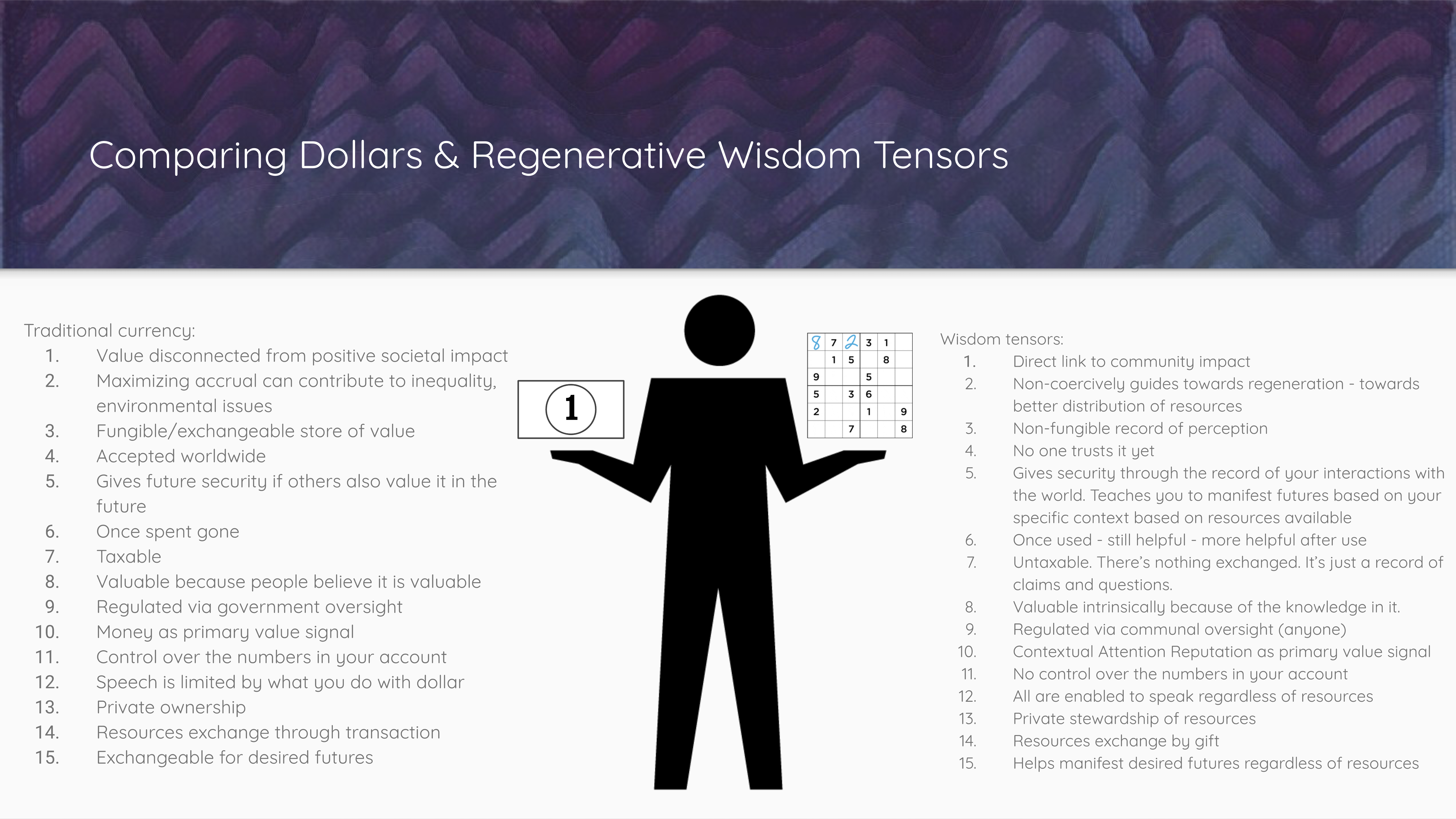
The distinction between dollars and regenerative wisdom tensors helps make this clear.
Money is fungible and exchangeable. Its value is largely disconnected from the detailed path by which someone came to know something. A staked belief is different. It is a non-fungible record of perception bound to a source, context, time, degree of certainty, and moral orientation.
Once useful knowledge is shared, it is not gone. It can become more useful as people test it, connect it to outcomes, translate it into new contexts, and compress it again. FourThought makes that accumulated wisdom legible enough for an Iris to learn from.
Reflective compression is one way to teach an Iris to preserve historical knowledge. It does not define the universal purpose of every Iris.
Generative Tension Between Objectives
An Iris can be trained through multiple objectives that do not move in lockstep.
That does not mean those objectives form one canonical list. It means FourThought and the Iris architecture are expressive enough to hold several demands in the same learning process.
A low-dimensional Iris trained on market data makes this visible concretely. The model below is learning from losses over ordinary coherent continuation, legacy cross-source relationships, and explicit-now interpolation across uniformly sampled source pairs.
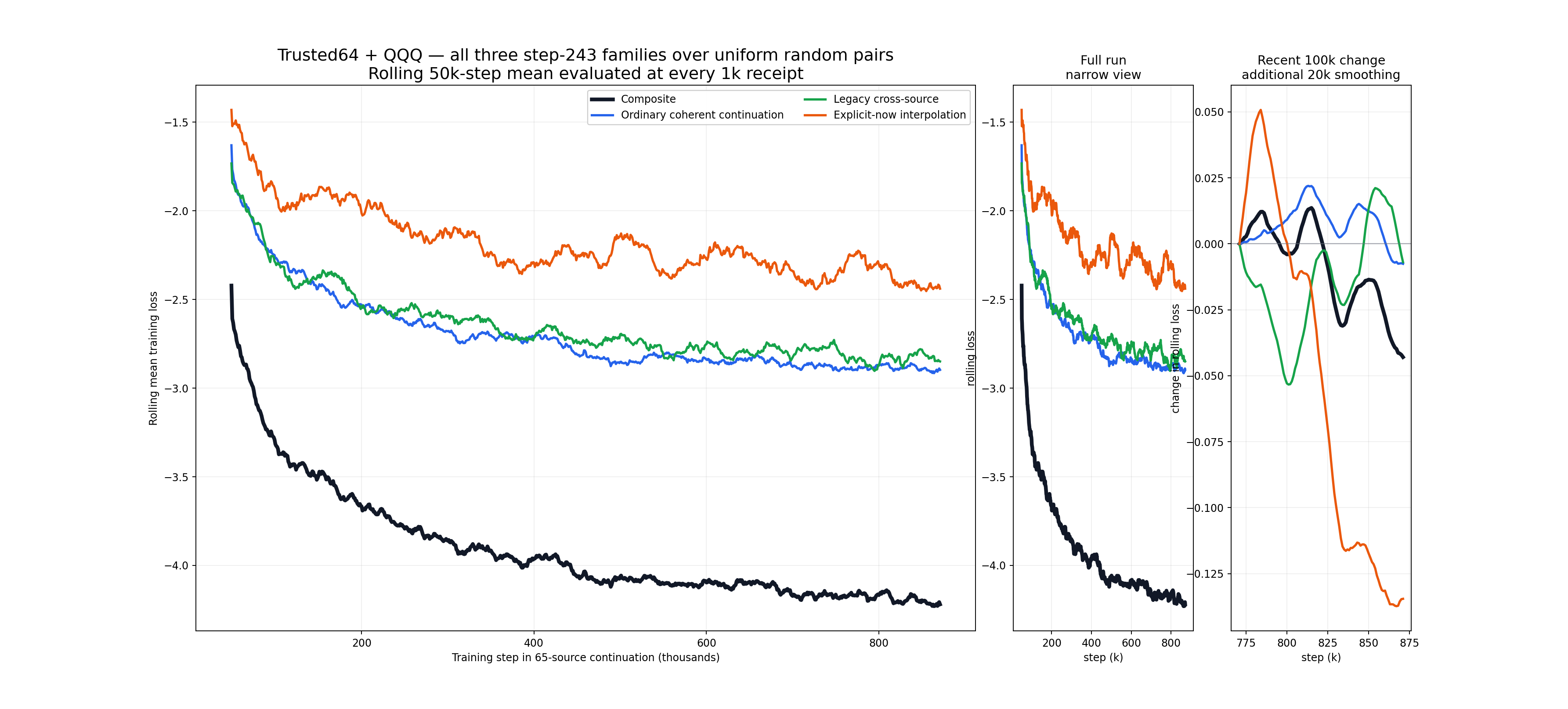
One component can improve sharply while another plateaus or temporarily moves the other way. The shared representation is being shaped by several relational demands at once.
The graph is a training receipt, not by itself a claim of held-market generalization. Its relevance here is architectural: an individual Iris can be taught with multiple partially conflicting objectives, and its representation develops through their interaction.
The same flexibility exists in a community Iris. A community may use the Prophet Incentive, Social Proof of Impact, fruitful questioning, reflective compression, and other techniques that emerge from how it uses FourThought. Different communities can choose different mixtures. New methods of evaluating the ledger can be developed without replacing the dialectic.
Teaching Iris
FourThought does not tell every Iris what to value. It gives people a sufficiently expressive way to teach.
Through staking, people can communicate:
- what they remember;
- what they believe now;
- what they expect;
- what they want to discover;
- how certain they are;
- what outcomes they value;
- which thoughts they are answering;
- what later experience changed their minds.
The Rhizome widget lets the person correct the model’s interpretation at the moment of staking. The continuing ledger lets the community correct both people and models over time. Individual Irises learn different attention patterns from different histories, contexts, and objectives.
The Prophet Incentive and Social Proof of Impact show two powerful mechanisms for shaping that learning. Fruitful questions and reflective compression show other possibilities. None exhaust what can be taught through FourThought.
The protocol is valuable because it leaves room for communities to discover new ways of teaching Iris while preserving a common language for staking belief.